Kinsey Scale History: Alfred Kinsey's Research & Legacy Explained
Long before today's open conversations about identity, the topic of human sexuality was shrouded in silence and assumption. Society largely viewed sexual orientation as a simple binary: you were one thing or the other. But what if that wasn't the full picture? How did one researcher's work completely change our understanding of attraction?
Ever wonder how one man's research flipped the script on sexuality? Let's dive into the Kinsey Scale's origins. His work provided a new language to describe the human experience, and its legacy continues to influence us today. Understanding this history is a powerful first step in any journey of self-discovery. To see how these ideas apply to you, you can start your exploration on our platform.
Alfred Kinsey: The Pioneer of Modern Sexology Research
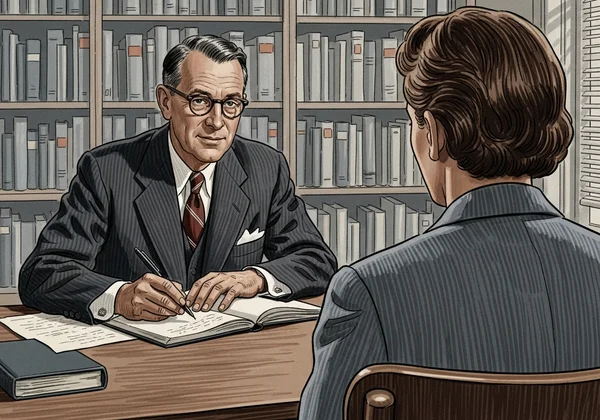
To understand the Kinsey Scale, you have to start with the man behind it. Alfred Kinsey was an unlikely revolutionary. He was a biologist, a professor at Indiana University, and the world's foremost expert on... gall wasps. His meticulous, data-driven approach to science, however, would soon be applied to a topic far more controversial and profoundly human.
From Entomology to Human Sexuality: Kinsey's Early Life
Born in 1894, Alfred Kinsey spent the early decades of his career as an entomologist. He collected and cataloged millions of gall wasp specimens, becoming famous for his precise and exhaustive research methods. He was interested in variation—how individuals within a species could differ so widely. This scientific curiosity about natural diversity would become the cornerstone of his later work.
In the late 1930s, Kinsey began teaching a course on marriage and family. He was shocked to find how little scientific data existed about human sexual behavior. His students came to him with questions, but the available literature was based more on moral beliefs than on empirical evidence. Seeing this gap, Kinsey decided to apply the same rigorous, objective methods he used on wasps to study people.
Challenging Norms: The Foundation of the Kinsey Institute
Kinsey's new research was radical for its time. He began collecting "sex histories" through anonymous, face-to-face interviews. His non-judgmental and scientific approach allowed people to speak candidly about their experiences. The project grew rapidly, and in 1947, he established the Institute for Sex Research at Indiana University, now known as the Kinsey Institute.
This institution became the epicenter for the scientific study of sex, gender, and reproduction. It was founded on the principle that knowledge should be based on facts, not assumptions. Kinsey and his team aimed to build the most comprehensive dataset on human sexuality ever assembled, an effort that would soon challenge the world's most fundamental beliefs about who we are.
The Genesis of the Kinsey Scale: How It Developed
The most famous outcome of Kinsey's research was the Heterosexual-Homosexual Rating Scale, now universally known as the Kinsey Scale. It wasn't something he planned from the start but rather an idea that emerged directly from the thousands of interviews his team conducted. He realized that people's lives and attractions didn't fit into neat boxes.
Methodology & Data Collection: Insights from the Kinsey Reports
Kinsey's work culminated in two landmark publications: Sexual Behavior in the Human Male (1948) and Sexual Behavior in the Human Female (1953). Together, these are known as the Kinsey Reports. Kinsey's team interviewed over 18,000 men and women. They came from diverse backgrounds across the U.S.
The interview process was meticulous. Each person was asked hundreds of questions about their sexual behaviors, thoughts, and attractions throughout their lives. The data revealed a staggering diversity in human experience that directly contradicted the social and moral norms of the era. The reports became bestsellers, sparking intense public debate and establishing sexology as a legitimate field of scientific inquiry. This groundbreaking work forms the basis of the insights you can explore the scale with today.
Beyond Dichotomy: Introducing the 0-6 Spectrum
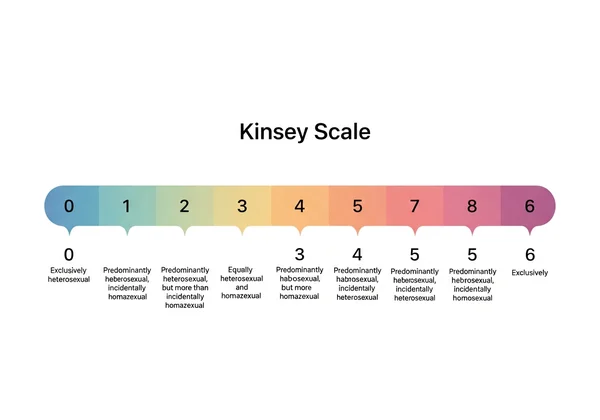
From his data, Kinsey made a revolutionary conclusion: sexuality is not a binary. He observed that many people reported both heterosexual and homosexual feelings and experiences. To capture this complexity, he developed a seven-point scale.
The Kinsey Scale ranges from 0 to 6:
- 0: Exclusively heterosexual
- 1: Predominantly heterosexual, only incidentally homosexual
- 2: Predominantly heterosexual, but more than incidentally homosexual
- 3: Equally heterosexual and homosexual
- 4: Predominantly homosexual, but more than incidentally heterosexual
- 5: Predominantly homosexual, only incidentally heterosexual
- 6: Exclusively homosexual
He also included an "X" category for individuals reporting no socio-sexual contacts or reactions. This spectrum was a radical idea. It suggested that sexual orientation could be fluid and exist on a continuum, a concept that continues to be a cornerstone of modern identity discussions.
Kinsey's Legacy: Cultural Impact and Enduring Relevance
The Kinsey Reports and the scale did more than just present data; they ignited a cultural revolution. By bringing private behavior into the public sphere, Kinsey’s research opened the door for more honest conversations about human sexuality and challenged the rigid social structures of the mid-20th century.
Societal Shockwaves: Public Reception and Criticisms
The public reaction was explosive. For many, the Kinsey Reports were liberating, offering validation that their private feelings were not abnormal. The research provided scientific language for experiences that many people felt but could not name. It was a crucial step toward de-stigmatizing diverse sexual behaviors.
However, the work also faced intense criticism. Some religious leaders and conservative politicians condemned it as immoral and an attack on traditional family values. Scientists critiqued his methods too. His sampling wasn't fully representative of everyone. Despite these criticisms, the impact was undeniable and permanent.
The Kinsey Scale in the 21st Century: Evolution of Understanding
So, is the Kinsey Scale still relevant today? Absolutely. Today, we recognize more identities like asexuality and pansexuality. The original scale didn't cover them all. Still, Kinsey's spectrum idea endures.
The scale was a foundational tool that paved the way for more nuanced models of attraction and identity. It taught us to move beyond simple labels and appreciate the complexity of human desire. It remains a valuable starting point for self-reflection and a powerful reminder that our experiences are part of a wide and varied human continuum. Engaging with this historical tool can be a meaningful part of your own journey, and you can easily take the test to see where you might fit on this spectrum.

Your Journey into the Spectrum: Understanding Sexuality's Rich History
The history of the Kinsey Scale is more than an academic footnote; it's the story of a scientific pioneer who dared to ask questions nobody else would. Alfred Kinsey’s research gave the world a new framework for understanding sexual orientation, shifting the conversation from moral judgment to scientific observation. His introduction of a spectrum celebrated human diversity and provided a tool that continues to empower individuals in their quest for self-knowledge.
This rich history provides the context for our modern explorations of identity. It reminds us that understanding ourselves is a journey, not a destination. If this history has sparked your curiosity, the next step is to see how these ideas relate to your own life.
Ready to continue your exploration? Begin your free test on our Kinsey Scale platform and discover your place on the spectrum.
Frequently Asked Questions About Kinsey's History
Who was Alfred Kinsey and why is he considered a pioneer?
Alfred Kinsey was an American biologist and professor who is widely regarded as the founder of modern sexology. His pioneering work involved applying rigorous scientific methods to the study of human sexual behavior, a field previously dominated by taboo and speculation. He is considered a pioneer because he collected one of the first and largest bodies of scientific data on the topic, challenging societal norms and opening the door for future research.
What were the main findings of the Kinsey Reports?
The Kinsey Reports revealed a significant discrepancy between public moral standards and actual private behavior. Key findings included that homosexual experiences were far more common than previously believed, that many people had experienced both heterosexual and homosexual attractions, and that there was a wide range of sexual behaviors that were a normal part of human experience.
How did the Kinsey Scale change our understanding of sexual orientation?
Before Kinsey, sexual orientation was seen as a strict binary—heterosexual or homosexual. The Kinsey Scale fundamentally changed this by introducing the concept of a continuum. It showed that sexuality is not an "either/or" proposition but a spectrum with varying degrees of attraction. This idea has been foundational to modern understandings of sexual fluidity and identity.
Is Kinsey's original research still considered valid today?
Kinsey's work is considered a critical historical foundation, but it is also viewed through a modern lens. While his core concept of a sexuality spectrum remains highly influential, contemporary researchers have pointed out limitations in his methodology, such as non-random sampling. Today, his work is valued more for its groundbreaking cultural impact and conceptual framework than for its precise statistics. To discover its relevance for you, many use the scale as a tool for personal reflection.