Percentage Homosexual: What Population Surveys Really Measure
Searching for a single percentage homosexual number can feel like asking a simple question, but population surveys do not all measure the same thing. Some count people who identify as gay or lesbian. Others include bisexual, transgender, queer, pansexual, asexual, or other identities. Some ask about attraction, and some ask about behavior. For readers who want a calm way to place numbers beside personal experience, a private Kinsey Scale self-reflection space can be a useful companion, as long as survey statistics are treated as context, not as a label for any one person.

The Short Answer: There Is No Single Homosexual Percentage
The most honest answer is that the percentage depends on what you mean by "homosexual." In everyday searches, people may use the word to mean gay men, lesbian women, anyone with same-sex attraction, anyone with same-sex behavior, or the broader LGBTQ+ population. Those are related, but they are not interchangeable.
In the United States, Gallup's 2025 data, published in February 2026, estimated that 9% of U.S. adults identify as LGBTQ+. That figure is not the same as the percentage who identify specifically as gay or lesbian. Gallup reported that bisexual identity remains the largest category inside the LGBTQ+ subgroup, while gay and lesbian identities each represent a smaller share of all U.S. adults.
So if someone asks, "What percentage of the U.S. is homosexual?" the careful answer is: gay and lesbian identity appears to be a few percent of adults in major U.S. surveys, while the broader LGBTQ+ share is higher. If the question is about attraction or behavior, the number may shift again.
Why Survey Percentages Vary So Much
The same population can produce different percentages because researchers ask different questions. A survey about identity asks, "Which label describes you?" A survey about attraction asks, "Who are you attracted to?" A survey about behavior asks, "Who have your partners been?" These do not always match neatly.
Identity, attraction, and behavior are different measures
Identity is the public or private word a person uses for themselves. Attraction is about patterns of desire, interest, or romantic feeling. Behavior is about experience. A person may identify as straight and still report some same-sex attraction. Another person may identify as bisexual but currently be in an opposite-sex relationship. Someone else may avoid labels entirely.
That is why the Kinsey Scale became influential: it encouraged people to think beyond a strict straight-versus-gay binary. Still, the scale is a framework for reflection, not a final statement about who someone is.
Wording, age, privacy, and culture change the result
Survey wording matters. Some questionnaires offer only "heterosexual, gay or lesbian, bisexual." Others include "something else," "queer," "pansexual," "asexual," transgender identity, or nonbinary identity. More inclusive options can produce a higher LGBTQ+ percentage because people see a label that fits them better.
Age also matters. Younger adults are more likely to report LGBTQ+ identities than older adults in many recent surveys. Privacy matters too: people may answer differently on a phone call than in an anonymous online questionnaire. Culture matters most of all. In places where stigma is high, fewer people may feel safe reporting a minority orientation or identity.
What Percentage of the U.S. Population Is LGBTQ+?
For the broad LGBTQ+ question, Gallup's 2025 estimate is a useful current benchmark: 9% of U.S. adults identified as lesbian, gay, bisexual, transgender, or something other than heterosexual. In the same data, 86% identified as heterosexual and 5% did not provide a response.
That means a rough plain-English translation is about 1 in 11 U.S. adults identifying as LGBTQ+. But that number should not be used as a direct "homosexual percentage." It includes multiple identities, and bisexual identity accounts for much of the growth in recent years.
The CDC's National Survey of Family Growth shows why the measurement question matters. Among men ages 18 to 49 in the 2017-2019 data, 7.3% reported ever having sexual activity with another man, while 3.2% reported such activity in the last 12 months. On attraction, 1.9% of men ages 18 to 49 reported being only attracted to the same sex, while additional groups reported mostly same-sex or equal attraction.
These figures answer different questions. None of them should be treated as the one true percentage.
What Percent of Gen Z Is LGBTQ+?
The younger the adult group, the higher the LGBTQ+ identification rate tends to be. Gallup's 2025 update reported that 23% of adults under 30 identify as LGBTQ+, compared with 10% among adults ages 30 to 49 and 3% or less among adults ages 50 and older.
This pattern does not prove that sexual orientation itself is simply "increasing." It may reflect several forces at once: more identity language, more visibility, less fear about answering, and a broader willingness to describe bisexual, queer, pansexual, asexual, or fluid experiences. The Survey Center on American Life has argued that much of the recent rise is concentrated among young adults, especially young women, and that bisexual identity explains a large part of the change.
Highest LGBT Population Country Percentage: What Global Surveys Show
Global comparisons are even trickier than U.S. comparisons. There is no complete worldwide census of sexual orientation, and many countries do not ask these questions in a comparable way. International online panels can be useful, but they may overrepresent people who are online, urban, educated, or comfortable answering sensitive questions.
In Ipsos' 2025 Pride report across 26 countries, Brazil had the highest reported LGBT+ self-identification share at 14%, followed by several countries in the low double digits. The United States appeared at 11% in that Ipsos online survey, which is higher than Gallup's 9% U.S. telephone estimate. That difference is a good reminder: country rankings depend on the survey mode, sample, wording, and identity categories included.
For searchers asking "highest LGBT population country percentage," the best answer is not just a ranking. It is a note of caution: the most accepting or visible country in one survey may not have the same percentage in another survey, and a high reported share can reflect safety and openness as much as underlying prevalence.
The Search for Top 10 Gayest States Needs Care
"Gayest states" is a common search phrase, but it is not the most respectful or precise wording. A better question is: which U.S. states or jurisdictions have the highest percentage of adults who identify as LGBT or LGBTQ+?
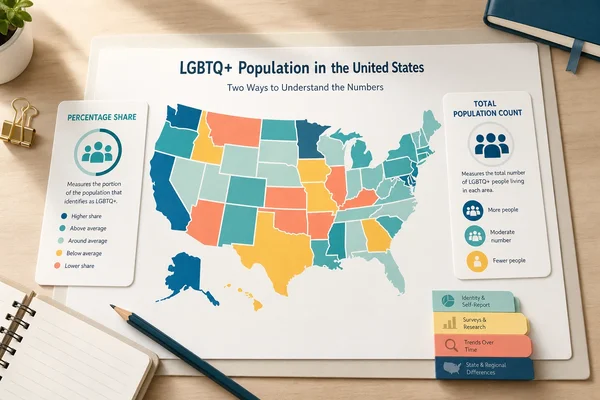
The Williams Institute's December 2023 report, using 2020-2021 BRFSS data, estimated that 5.5% of U.S. adults identified as LGBT and that Washington, D.C. had the highest share at 14.3%. The same report estimated 13.9 million LGBT adults in the United States and noted that California had the largest number of LGBT adults by count, largely because it has such a large population.
Percentage and population count are different. A smaller jurisdiction can rank high by percentage, while a large state can rank high by total number of LGBTQ+ residents. When reading any "top 10" list, check whether it ranks by share of adults, raw population, metro area, age group, or survey year.
Percentage of Homosexuality in Mammals and Nature
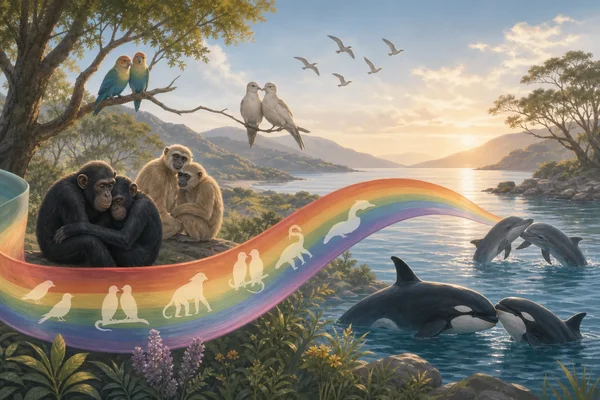
Searches about "percentage of homosexuality in mammals" need an extra layer of care because animal studies usually measure same-sex sexual behavior, not human-style identity. Nonhuman animals do not answer survey questions about labels. Researchers observe behavior such as courtship, mounting, pair bonding, genital contact, or alliance-building.
Nature Communications reported in 2023 that same-sex sexual behavior has been documented in more than 1,500 animal species across major animal groups. In mammals, researchers have found that same-sex sexual behavior is not randomly distributed and is especially discussed in social species and primates. The authors suggested it may sometimes play roles in bonding, alliance formation, or conflict management.
That does not mean researchers can assign animals a "homosexual percentage" in the same way a human population survey might. It does show that same-sex behavior is part of the natural world and that simple claims about what is "natural" are usually too narrow.
How to Read a Percentage Without Turning It into a Label
The safest way to read these numbers is to ask four questions.
First, what exactly was counted: gay or lesbian identity, broader LGBTQ+ identity, same-sex attraction, same-sex behavior, or public acceptance? Second, who was surveyed: adults, teens, people under 30, one country, one state, or a global online panel? Third, how was the question asked? Fourth, what year was the data collected?
This is also where the Kinsey Scale framework can help people think more gently. It does not require every person to fit one fixed box. It invites reflection on patterns, experience, and uncertainty. A percentage can describe a population, but it cannot decide what a particular feeling means for an individual.
Putting Homosexual Percentage Data in Personal Context
Population data can reduce isolation. If you have wondered whether same-sex attraction, bisexuality, fluidity, or uncertainty is rare, current surveys show that many people report experiences outside a strict heterosexual-only category. But numbers are not instructions. They do not require you to adopt a label, change a label, or explain yourself before you are ready.
If you are exploring your own orientation, use statistics as background and your lived experience as the foreground. Notice patterns over time. Pay attention to emotional safety. Read broadly. Talk with trusted people if that feels supportive. And if sexuality questions connect with distress, family pressure, safety concerns, or mental health concerns, consider speaking with a qualified professional or LGBTQ+ affirming support organization.
For a low-pressure next step, you can explore an orientation self-reflection tool and treat the result as a prompt for thought, not a permanent label. The percentage homosexual question is useful when it opens curiosity. It becomes less useful when it tries to reduce human experience to one number.
FAQ
Is homosexuality increasing or decreasing?
Reported LGBTQ+ identification has increased in the United States over the last decade, especially among younger adults. That does not necessarily mean same-sex attraction itself has changed at the same rate. Some of the increase likely reflects greater visibility, safer reporting, broader identity language, and more people choosing labels such as bisexual, queer, or pansexual.
Who has the highest population of gays?
It depends whether you mean percentage or total count. In U.S. state-level data from the Williams Institute, Washington, D.C. had the highest percentage of LGBT adults, while California had the largest total number of LGBT adults. In country-level online surveys, Brazil has ranked high in recent Ipsos LGBT+ self-identification data.
What percentage of men are attracted to other men?
It depends on the age range and wording. In CDC NSFG 2015-2019 data for men ages 18 to 49, 1.9% reported being only attracted to the same sex, while smaller additional shares reported mostly same-sex or equal attraction. Behavior and identity figures differ from attraction figures.
What percentage of women are lesbians?
Survey estimates vary by wording. In CDC NSFG 2015-2019 data for women ages 18 to 49, gay or lesbian identity was reported at about 2% to 2.7% depending on the version of the question, while bisexual identity was higher. Broader LGBTQ+ surveys include additional identity categories.
What percentage of straight people are in the world?
There is no single worldwide percentage because countries collect sexual orientation data differently, and many do not collect it at all. In Gallup's 2025 U.S. data, 86% of adults identified as heterosexual. Global online surveys show different figures by country and should be read as survey estimates, not a world census.
Does animal same-sex behavior prove anything about human identity?
It does not prove a person's identity, and it should not be used that way. Animal research shows that same-sex behavior exists widely in nature, but human sexual orientation includes identity, attraction, culture, language, and personal meaning. The better takeaway is that nature is more varied than simple stereotypes suggest.