What Causes Sexual Orientation? A Clear, Research-Aware Guide
What causes sexual orientation is one of those questions that sounds simple until you look closely. The most careful answer is that sexual orientation appears to develop through a complex mix of biological, developmental, and personal factors, with no single switch, gene, upbringing pattern, or conscious decision explaining everyone. Orientation is also different from behavior, labels, or relationship history. For readers who want a private way to think about attraction as a spectrum rather than a fixed box, a private orientation reflection tool can be a gentle starting point, not a final verdict.

The Short Answer: Orientation Has No Single Cause
Most scientists and major health organizations describe sexual orientation as a lasting pattern of romantic, emotional, or sexual attraction. It may be toward people of a different gender, the same gender, more than one gender, or no one in a sexual way. It is not the same as gender identity, sexual behavior, relationship status, or the words a person chooses for themselves.
The strongest broad consensus is not that researchers have found one clear cause. It is that simplistic explanations do not hold up well. Sexual orientation is not explained by one childhood event, one parenting style, one personality trait, one social influence, or one moment of choice. Many people recognize attraction early in life. Others understand it later, especially if culture, safety, religion, family expectations, or language made those feelings hard to name.
That matters because the question "what makes sexual orientation" can easily slide into pressure: Who made me this way? Can I change it? Did something cause it? A healthier frame is developmental. Orientation is part of how attraction patterns become organized over time. For many people, it feels discovered more than selected.
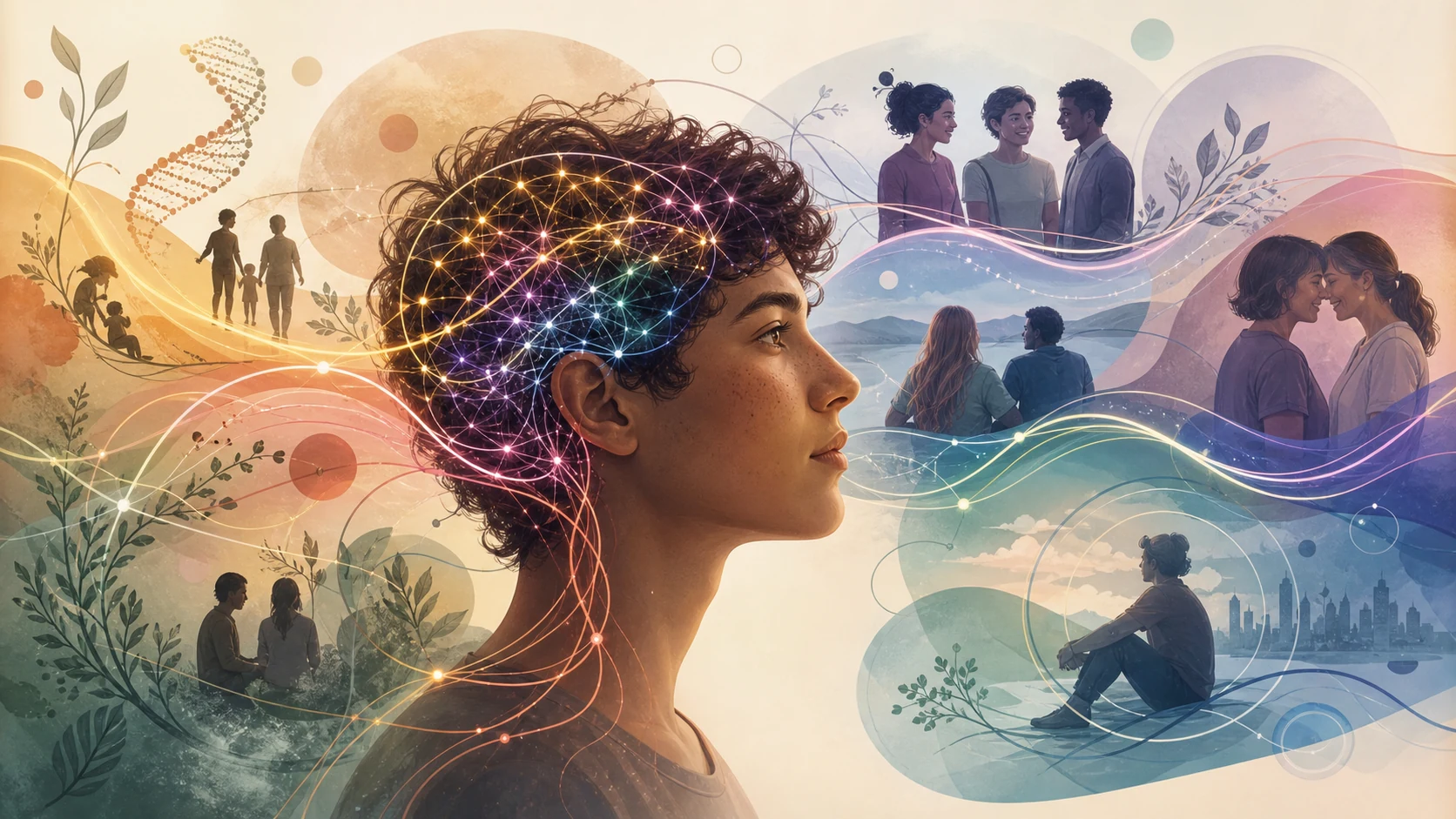
How Biology, Development, and Genetics May Contribute
Research points to biological influences, but it does not support a single "gay gene" or a simple DNA test for orientation. Large genetic studies suggest that many genetic variants may have small associations with same-sex sexual behavior, yet those patterns cannot meaningfully predict an individual's orientation. Biology may matter, but biology is not destiny in a neat one-to-one way.
Development before birth is also discussed in research, especially prenatal hormonal environments and early brain development. These areas are complex, and the evidence is easier to summarize carefully than to oversimplify. Researchers study correlations across populations; they do not read one person's body or family history and determine exactly why that person is straight, gay, bisexual, asexual, queer, questioning, or somewhere else on the spectrum.
This is where a spectrum model can help. Instead of asking whether one factor "created" an orientation, it may be more accurate to ask how a person's patterns of attraction, response, fantasy, affection, and identity fit together. The Kinsey Scale is not a complete modern model of sexuality, but its orientation spectrum framework can help people step away from a strict either-or view.
What Causes Sexual Attraction Between Two People?
Sexual orientation is about broad patterns of attraction, while attraction between two specific people is more immediate and situational. Someone may notice another person's appearance, voice, scent, confidence, kindness, humor, emotional safety, shared values, or body language. Context also matters. Familiarity, novelty, timing, stress, closeness, and mutual attention can all shape whether attraction is felt strongly, faintly, or not at all.
That does not mean attraction is fully controllable. People can choose how they act, communicate, set boundaries, and build relationships, but they usually do not choose the basic direction or presence of attraction. A straight man does not typically decide to be attracted to women as a project. A lesbian woman does not usually reason herself into attraction to women. A bisexual person does not select multiple-gender attraction as a preference setting. An asexual person does not lack sexual attraction because they forgot to choose one.
The difference between orientation and momentary attraction also explains why people can be surprised by themselves. A person may identify as straight and still notice an unexpected attraction. Someone may identify as gay and have a complicated past relationship. Someone may feel romantically drawn to one gender and sexually drawn in a different pattern. These experiences do not automatically erase a person's identity; they invite reflection.
Is Sexual Orientation a Choice?
The short answer is no in the ordinary sense of choice. People make choices about dating, disclosure, labels, community, boundaries, and behavior. They do not usually choose who they are capable of feeling attraction toward.
This distinction is important because the phrase "sexual preference" can sound like selecting a favorite color or food. Some people use the phrase casually, but "sexual orientation" is usually more accurate when discussing enduring attraction patterns. "Preference" may suggest voluntary selection, while many people experience orientation as something they recognize, understand, and integrate over time.
For some readers, the more personal question is not "Did I choose this?" but "Why does my experience feel different from what I expected?" That question deserves room. A person might have grown up with one script for what attraction was supposed to look like, then later notice that real attraction is broader, quieter, more fluid, or more specific than the script allowed.
Can Sexual Orientation Change Over Time?
Some people describe their orientation as stable for most of life. Others describe shifts in how they understand, label, or experience attraction. Sexual fluidity can mean different things: a genuine change in felt attraction, a new awareness of feelings that were already there, a safer environment for naming them, or a better vocabulary for describing nuance.
It is important not to turn fluidity into pressure. The fact that some people experience change does not mean anyone can force orientation to change, or that a person's current identity is temporary. It also does not mean every moment of uncertainty needs a label immediately.
The most respectful approach is to let self-understanding unfold without treating one test result, one crush, one relationship, or one period of questioning as the whole story. Attraction can be patterned and still complicated. Identity can be meaningful and still open to revision. A person can use language that fits today without promising it will fit forever.
What About Sexual Orientation OCD and Anxiety?
Searches about what causes sexual orientation sometimes overlap with anxiety, rumination, or intrusive doubts. Some people repeatedly check their reactions, compare memories, look for reassurance online, or fear that a passing thought has "proved" something about them. This can feel exhausting, especially when the question is less about curiosity and more about distress.
Educational articles can explain concepts, but they cannot evaluate an individual's mental health. If worries about orientation become repetitive, unwanted, time-consuming, or disruptive, it may help to speak with a qualified mental health professional who understands anxiety and LGBTQ+ topics. Supportive care should reduce shame and help people relate to uncertainty more gently. It should not pressure someone toward a predetermined identity or try to make them straight, gay, bisexual, or anything else.
For ordinary questioning, reflection can be useful. For spiraling fear, endless reassurance seeking usually makes the loop stronger. A helpful next step may be to notice whether the question feels open and curious or urgent and compulsive. That difference can guide what kind of support is needed.
How to Think About Your Own Orientation Without Forcing an Answer
Self-reflection works best when it is low-pressure. You do not need to solve your entire identity in one sitting. Instead, consider patterns across time. Who do you tend to notice? What kinds of emotional closeness feel romantic, sexual, both, or neither? Are your attractions mostly about gender, personality, context, intimacy, aesthetics, fantasy, or some combination?
It can also help to separate four layers:
- Attraction: who you feel drawn to emotionally, romantically, or sexually.
- Behavior: what you have done or chosen not to do.
- Identity: the words that feel honest or useful for you.
- Community: where you feel seen, supported, or understood.
These layers can line up neatly, but they do not always. Someone can have limited experience and still know something important about their orientation. Someone can have a relationship history that does not perfectly match their current label. Someone can be unsure and still deserve respect.

Using Spectrum Tools as a Starting Point
If you are exploring what causes sexual orientation because you are trying to understand yourself, a spectrum-based tool can offer language for reflection. The Kinsey Scale uses a 0-6 range, plus an X category, to describe patterns of attraction and response in a way that moves beyond a strict straight-versus-gay binary. It is historically influential, but it is also limited. It cannot capture every part of identity, romantic attraction, asexuality, gender diversity, culture, or personal meaning.
That is why the best use of a Kinsey Scale self-reflection experience is exploratory. Treat any result as a prompt: What fits? What feels incomplete? What surprised me? What would I want to understand better? A score can organize a thought, but it should not replace your lived experience, your boundaries, or supportive conversations with trusted people.
In the end, what causes sexual orientation is not a puzzle with one universal answer. It is a human development question with biological, psychological, social, and personal dimensions. You do not need a perfect origin story to take your attractions seriously. Understanding can begin with patience, honest language, and enough room for complexity.
FAQ
How is sexual orientation decided?
Sexual orientation is not usually "decided" like a conscious plan. It appears to develop through a complex mix of biological and developmental influences, personal awareness, and lived experience. People may choose labels and behaviors, but attraction itself is generally experienced rather than selected.
Is sexual orientation a mental disorder?
No. Being gay, lesbian, bisexual, straight, asexual, queer, or questioning is not a mental disorder. A person may still seek mental health support for anxiety, stress, relationships, stigma, or identity-related questions, but orientation itself is not an illness.
What is the most common sexual orientation?
In many surveys, heterosexual or straight identity is the most commonly reported orientation. That does not make it more valid than other orientations. It may also reflect how surveys are designed, whether people feel safe answering honestly, and what labels are available.
What affects your sexual orientation?
Research suggests orientation may be influenced by multiple factors, including biology, genetics, prenatal development, and personal development. No single factor explains everyone, and researchers cannot identify one simple cause for a particular person's orientation.
What causes sexual orientation to change?
Some people report changes in attraction, while others report changes in awareness or labels. A shift may reflect new self-understanding, safer circumstances, different relationships, or genuine fluidity. It should not be used as evidence that anyone can force orientation to change.
What causes sexual attraction in humans?
Sexual attraction can involve biology, sensory cues, emotional connection, personality, context, familiarity, novelty, and personal meaning. Orientation describes broader patterns of attraction, while attraction to a specific person can depend on many immediate and relational factors.
Is sexual preference the same as sexual orientation?
Not exactly. "Sexual preference" is sometimes used casually, but it can imply voluntary choice. "Sexual orientation" is usually the clearer term for enduring patterns of romantic, emotional, or sexual attraction.